



How to really taste an EVO oil: among aromas, gestures and the identity of Sabina
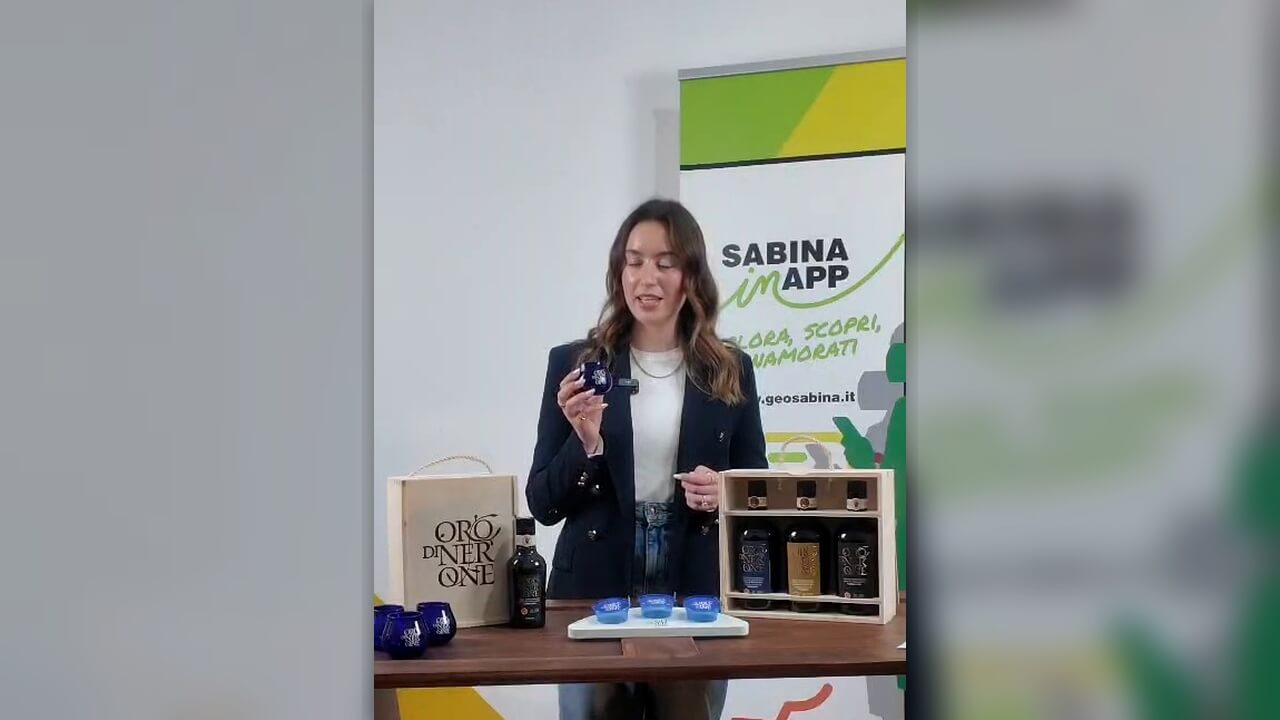
In a new video, Rebecca Magrini guides us through the tasting of EVO oil, among the blue tasting glass, aromas and the identity of Sabina.
In Sabina, extra virgin olive oil is not just a product on the table. It is a daily gesture, an ancient habit, a presence that accompanies the landscape and the life of this territory. Among olive groves, harvesting and mills, oil tells of a deep relationship with the land, shaped by work, care and memory. For this reason, learning how to taste it also means getting closer, in a more authentic way, to one of the most recognisable expressions of Sabina.
This is where the story shared by GeoSabina with Rebecca Magrini begins. Rebecca is a professional extra virgin olive oil taster at the Società Agricola Magrini in Forano, where ‘Oro di Nerone’, a DOP Organic extra virgin olive oil, is produced. Her contribution helps us look at oil differently, not as something to take for granted, but as a product to be listened to carefully, letting the senses lead the way.
The starting point is simple but essential: to understand whether an oil is good or flawed, we need to recognise three specific aspects, namely fruitiness, bitterness and pungency. These are not abstract or overly technical words reserved for specialists, but very concrete references that allow us to truly enter the character of the oil.
Tasting begins with the blue glass
Even before taste comes into play, tasting begins with the way we prepare to encounter the oil. Rebecca shows a step that immediately stands out for its simplicity: the oil is tasted neat, without bread or other foods, using a non-transparent tasting glass, in this case blue. The reason is precise: colour must not influence the judgement. Attention should be directed to aromas and sensations, not to visual appearance.
This detail also conveys the true meaning of tasting: stopping, slowing down, removing what is unnecessary. In the end, truly tasting means exactly this, giving space to what the oil has to express, without distractions.
Warming the oil to listen to its aromas
The tasting glass should be rotated gently in the hands to warm it slightly. It is a simple gesture, but it changes everything, because the warmth helps the oil open up and release its aromatic profile. This is the moment when the nose begins to perceive what the oil has to say: its finest aromas, or any unpleasant odours.
When the oil is good, the notes come through clearly, vividly and cleanly. In this case, highly recognisable vegetal hints emerge, such as cut grass, artichoke and tomato, typical of Sabina olive oil. These are aromas that immediately speak of freshness and authenticity, but they also evoke something more: carefully cultivated countryside, a season, a land expressing itself through its products.
And perhaps it is right here that tasting stops being only a technique and becomes a small story of the territory.
Fruitiness, bitterness and pungency: three keys to understanding an oil
Rebecca clearly points out the three elements to evaluate. Fruitiness refers to the sensation of healthy, fresh, lively fruit. Bitterness and pungency, on the other hand, should not be read as defects, but as positive characteristics when they are balanced and harmonious.
This is an important point, because people often think that a delicate, almost neutral oil is automatically better. In reality, a quality extra virgin olive oil can have personality, intensity and energy. It can leave a vivid sensation on the palate, something memorable. And precisely this strength, when well balanced, is one of the signs that help us recognise an authentic oil.
The second phase: strip tasting
After the aromatic phase comes the second stage of tasting, known as strip tasting. This is the technique that allows air to be drawn in together with the oil, so that it spreads more effectively in the mouth and its aromatic and flavour characteristics can be perceived more clearly.
Even this gesture, which at first glance may seem technical, actually brings us back to a very concrete dimension: learning to distinguish, to pay attention, to better understand what is in front of us. Not to turn every tasting into an exam, but to develop a more aware sensitivity towards a product that, in Sabina, has a deep value.
Looking at oil with greater awareness
Perhaps the most beautiful value of this story lies precisely here: in reminding us that behind such a familiar food there is a world rich in nuances. Tasting an oil with attention means recognising its quality, but also giving more meaning to what we place on our table every day.
In its aromas, in the balance between fruitiness, bitterness and pungency, in the gestures of tasting, there is an important part of Sabina’s identity.
Watching the video with Rebecca Magrini means taking a small step into this culture: a simple, concrete and authentic invitation to know extra virgin olive oil better and, at the same time, to know Sabina better.
To explore further, you can also discover the page dedicated to the Società Agricola Magrini on GeoSabina and continue the journey through the flavours and excellences of Sabina.
Per approfondire, puoi scoprire anche la scheda dedicata alla Società Agricola Magrini su GeoSabina e continuare il viaggio tra i sapori e le eccellenze della Sabina.